
Understanding Financial Business Models: The Foundation of Strategic Planning
The interconnected components of a comprehensive financial business model
A financial business model is a structured representation of a company’s financial operations, designed to forecast future performance based on historical data and well-defined assumptions. Unlike simple budgets or projections, a comprehensive financial model integrates multiple business aspects into a cohesive analytical framework.
Why Financial Modeling Matters for Business Success
Financial modeling isn’t just for large corporations or investment bankers. Businesses of all sizes benefit from well-constructed financial models that enable:
- Data-driven decision making based on quantitative analysis rather than gut feeling
- Strategic planning with clear visibility into future financial implications
- Risk assessment through scenario testing before committing resources
- Investor communication with credible financial projections
- Performance tracking against established benchmarks
- Resource allocation optimization across business units
According to a Harvard Business Review study, companies that make decisions based on data-driven financial models achieve 5-6% higher productivity and profitability than their competitors. This advantage stems from the ability to anticipate market changes, identify growth opportunities, and mitigate potential risks before they materialize.
Different Types of Financial Models for Various Business Needs
| Model Type | Primary Purpose | Key Components | Best For |
| Three-Statement Model | Core financial forecasting | Income statement, balance sheet, cash flow statement | Foundation for all business planning |
| Discounted Cash Flow (DCF) | Business valuation | Projected cash flows, terminal value, discount rate | Investment decisions, company valuation |
| Budget Model | Operational planning | Departmental expenses, revenue targets, variance analysis | Annual planning, performance tracking |
| Merger & Acquisition Model | Transaction analysis | Synergy analysis, accretion/dilution impact | M&A transactions, corporate development |
| Working Capital Model | Cash flow management | Accounts receivable, inventory, accounts payable | Cash flow optimization, liquidity planning |
Before diving into the step-by-step process, it’s important to understand that financial modeling is both an art and a science. The science involves applying financial principles and mathematical formulas correctly, while the art lies in making reasonable assumptions and creating a model structure that accurately reflects your unique business dynamics.
Step 1: Define Your Modeling Objectives

The first and most crucial step in building an effective financial business model is clearly defining what you want to achieve. Without specific objectives, you risk creating an overly complex model that doesn’t address your actual business needs.
Common Financial Modeling Objectives
Strategic Planning
Models designed for strategic planning typically forecast 3-5 years ahead and focus on high-level business drivers rather than granular details. These models help answer questions like “Should we enter a new market?” or “How will our growth strategy impact profitability?”
Fundraising
When seeking investment, your financial model needs to demonstrate market opportunity, growth trajectory, and potential return on investment. Investors will scrutinize your assumptions, so they must be well-researched and defensible.
Operational Planning
These models focus on shorter time horizons (12-18 months) with greater detail, often including monthly or quarterly projections. They’re essential for budgeting, resource allocation, and performance tracking.
Valuation
Valuation models, particularly discounted cash flow (DCF) analyses, help determine the intrinsic value of a business based on projected future cash flows. These are critical for M&A transactions, investment decisions, and strategic exits.
Scenario Analysis
These models test the impact of different variables on business outcomes. For example, how would a 10% decrease in sales affect your cash position? What if production costs increase by 15%?
Cash Flow Management
Cash flow models focus specifically on liquidity, helping businesses ensure they maintain sufficient cash to meet obligations while optimizing working capital.
“The purpose of a financial model is not to predict the future with perfect accuracy, but to help you make better decisions in the face of uncertainty.”
Defining Your Model’s Scope and Detail Level
Once you’ve identified your primary objective, you need to determine the appropriate scope and level of detail for your model. Consider these factors:
| Factor | Considerations |
| Time Horizon |
|
| Business Complexity |
|
| Audience |
|
| Available Data |
|
Need Help Defining Your Financial Modeling Objectives?
Download our free Financial Modeling Objectives Worksheet to clarify your goals and determine the right scope for your business model.
Step 2: Gather Historical Data and Market Research

A financial model is only as good as the data that powers it. This step involves collecting both internal historical data and external market information to establish a solid foundation for your projections.
Internal Historical Data Collection
For established businesses, historical performance provides the most reliable basis for future projections. Gather at least 2-3 years of historical data, including:
- Financial statements: Income statements, balance sheets, and cash flow statements
- Sales data: Revenue by product/service, customer segment, and geographic region
- Cost structure: Fixed vs. variable costs, cost of goods sold, operating expenses
- Operational metrics: Production volumes, capacity utilization, efficiency ratios
- Customer metrics: Acquisition costs, lifetime value, churn rates
- Working capital trends: Inventory turnover, accounts receivable days, accounts payable days
For startups or new business initiatives without historical data, you’ll need to rely more heavily on market research, industry benchmarks, and reasonable assumptions based on comparable businesses.
Market Research and Industry Benchmarking
External data helps validate your assumptions and provides context for your projections. Key sources include:
Industry Reports
Reports from sources like IBISWorld, Gartner, or industry associations provide market size, growth rates, and trend analysis.
Competitor Analysis
Public company financial statements, investor presentations, and annual reports offer insights into competitor performance and business models.
Economic Indicators
GDP growth, inflation rates, interest rates, and sector-specific indicators help frame your projections within the broader economic context.
Customer Research
Surveys, interviews, and focus groups provide qualitative insights into customer preferences, willingness to pay, and potential demand.
Benchmarking Data
Industry benchmarks for key metrics like gross margins, operating expenses, and growth rates help validate your assumptions.
Expert Opinions
Consultations with industry experts, advisors, and experienced professionals can provide valuable insights not available in published sources.
Top-Down vs. Bottom-Up Forecasting Approaches
When gathering data for your financial model, consider using both top-down and bottom-up approaches:
- Top-down: Start with market size and work downward (e.g., “If the market is $1 billion and we capture 2%, our revenue would be $20 million”)
- Bottom-up: Start with specific operational drivers and build upward (e.g., “With 10 salespeople each closing 2 deals per month at $50,000 per deal, our annual revenue would be $12 million”)
The most robust financial models reconcile both approaches to ensure projections are both ambitious and achievable.
Data Organization and Validation
Before incorporating data into your model, take time to organize and validate it:
- Standardize data formats and time periods for consistency
- Identify and address any data gaps or anomalies
- Reconcile data from different sources to ensure accuracy
- Document data sources and any adjustments made
- Verify data accuracy through cross-checking and validation
Remember that the quality of your data directly impacts the reliability of your financial model. Invest time in thorough data collection and validation to build a solid foundation for your projections.
Step 3: Structure Your Financial Model Framework
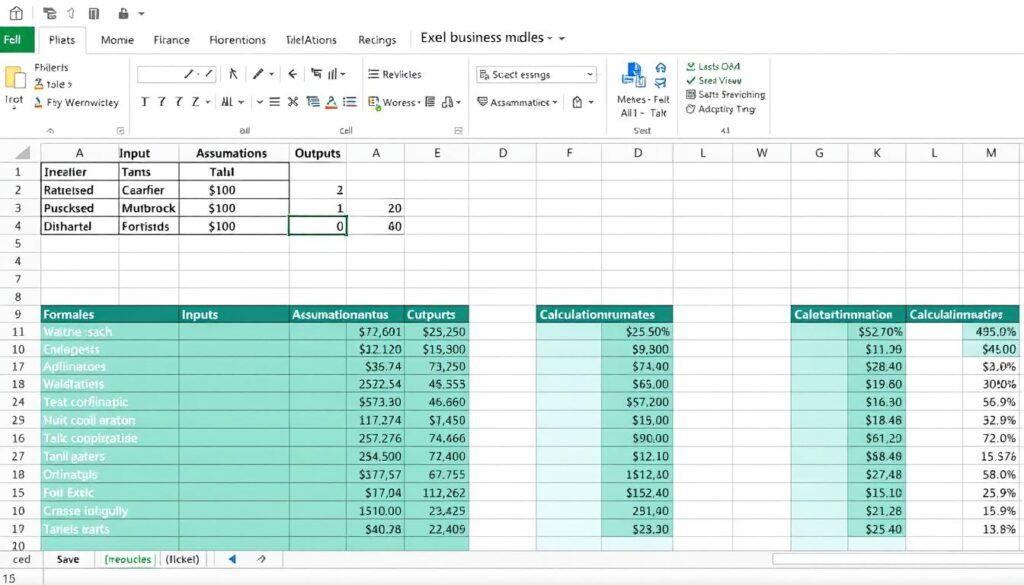
With clear objectives and reliable data in hand, it’s time to design the structure of your financial model. A well-organized framework makes your model easier to build, understand, and maintain over time.
Best Practices for Financial Model Structure
Financial modeling experts recommend following these structural best practices:
Separate Inputs, Calculations, and Outputs
Organize your model into three distinct sections:
- Inputs: All assumptions and variables that drive the model
- Calculations: Formulas and logic that process the inputs
- Outputs: Summary tables, financial statements, and visualizations
This separation makes it easier to update assumptions without disrupting calculations and helps others understand your model’s logic.
Consistent Time Periods
Maintain consistent time periods across all sections of your model. Common approaches include:
- Monthly detail for the first 1-2 years
- Quarterly detail for years 2-3
- Annual detail for years 4-5 and beyond
Whatever structure you choose, apply it consistently throughout your model to avoid timing mismatches.
Color Coding for Clarity
Use consistent color coding to distinguish between different types of cells:
| Cell Type | Recommended Color | Purpose |
| Input cells | Blue | Assumptions and variables that users can change |
| Calculation cells | Black | Formulas that should not be modified |
| Linked cells | Green | References to other worksheets |
| Check cells | Red | Error checks and validation |
Essential Components of a Financial Model
A comprehensive financial model typically includes these key components:
- Assumptions Sheet: Centralized location for all model inputs and drivers
- Revenue Forecast: Projections based on key revenue drivers
- Cost Structure: Fixed and variable costs, COGS, operating expenses
- Capital Expenditures: Investment in long-term assets
- Working Capital: Inventory, accounts receivable, accounts payable
- Debt Schedule: Existing and projected debt, interest payments
- Depreciation Schedule: Asset depreciation over time
- Income Statement: Projected profit and loss
- Balance Sheet: Projected assets, liabilities, and equity
- Cash Flow Statement: Projected cash inflows and outflows
- Valuation: DCF analysis, multiples, or other valuation methods
- Scenario Analysis: Base, best, and worst-case scenarios
- Dashboard: Summary of key metrics and visualizations
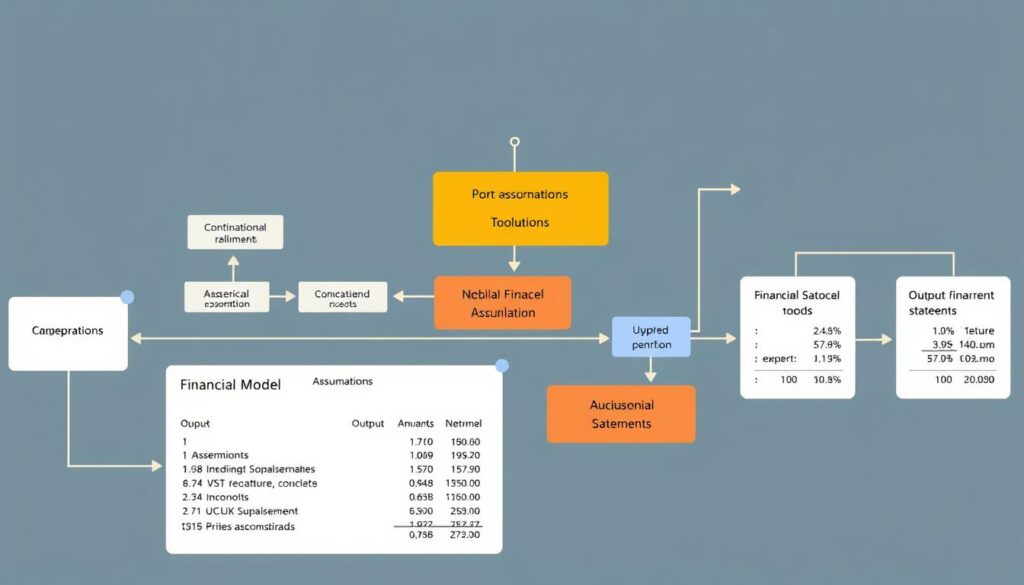
The interconnected components of a comprehensive financial model
Building a Flexible, Scalable Model
Design your model with flexibility and scalability in mind:
- Modular design: Build separate modules for different business components that can be updated independently
- Dynamic formulas: Use relative and absolute cell references appropriately to allow for easy expansion
- Named ranges: Define named ranges for key inputs and calculations to improve formula readability
- Data tables: Use Excel data tables for sensitivity analysis
- Documentation: Include notes and comments explaining complex calculations and assumptions
- Error checks: Build in validation checks to identify inconsistencies (e.g., balance sheet balancing)
Ready to Structure Your Financial Model?
Download our Financial Model Structure Template with pre-built tabs, color coding, and formatting to jumpstart your modeling process.
Step 4: Develop Revenue and Cost Projections

Revenue and cost projections form the core of your financial model. This step requires careful analysis of business drivers and thoughtful assumptions about future performance.
Revenue Forecasting Techniques for Financial Business Models
Effective revenue forecasting combines art and science. Consider these approaches based on your business type:
| Business Type | Forecasting Approach | Key Drivers | Example Formula |
| Product-Based | Unit Economics | Units sold × Price per unit | Monthly units × Average selling price × (1 + price increase %) |
| Service-Based | Capacity Utilization | Billable hours × Hourly rate | Consultants × Utilization rate × Billable hours × Hourly rate |
| Subscription | Cohort Analysis | Subscribers × ARPU × Retention | Starting subscribers + New subscribers – Churned subscribers) × Monthly ARPU |
| E-commerce | Conversion Funnel | Traffic × Conversion rate × AOV | Monthly visitors × Conversion rate × Average order value |
| Project-Based | Pipeline Analysis | Project value × Win probability | Sum of (Project value × Win probability × Timing adjustment) |
“The most important thing about revenue forecasting isn’t perfect accuracy—it’s understanding the key drivers that influence your business and how they interact.”
Cost Structure Analysis and Projection
Develop a detailed understanding of your cost structure to create accurate projections:
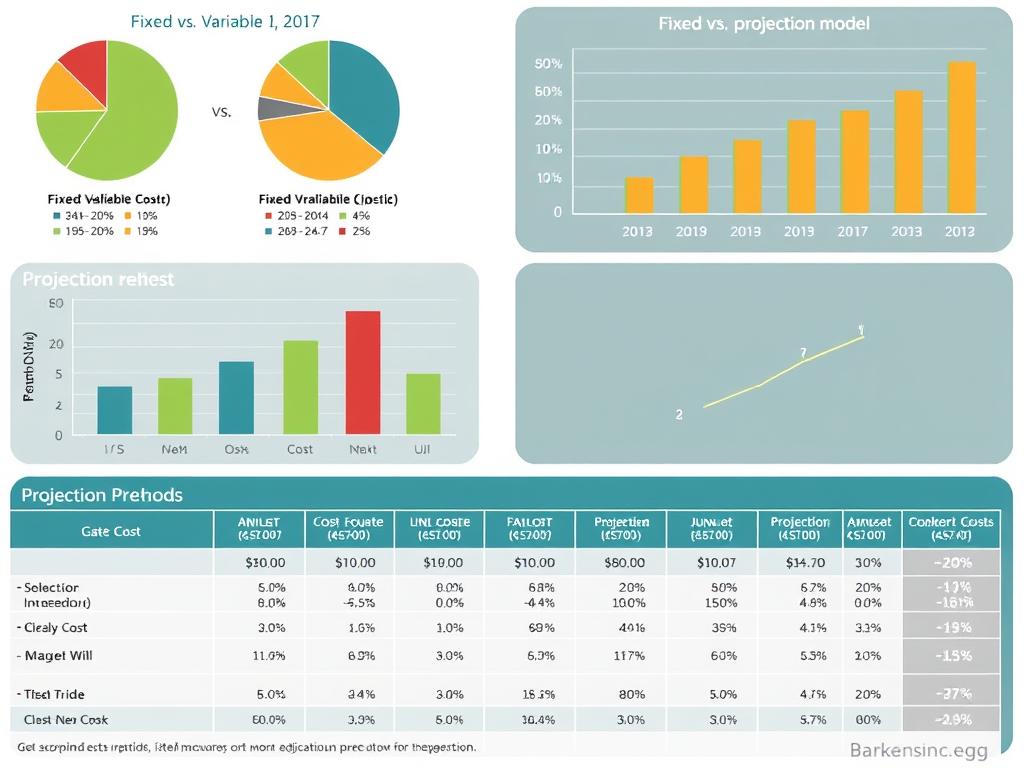
Fixed vs. Variable Costs
Categorize costs based on their relationship to business volume:
- Fixed costs: Remain constant regardless of sales volume (rent, salaries, insurance)
- Variable costs: Change proportionally with sales volume (materials, commissions, transaction fees)
- Semi-variable costs: Have both fixed and variable components (utilities, some labor costs)
This categorization helps you understand how costs will scale as your business grows.
Direct vs. Indirect Costs
Another useful categorization:
- Direct costs: Directly attributable to producing goods/services (materials, direct labor)
- Indirect costs: Support the business but aren’t directly tied to production (administrative expenses, marketing)
Understanding this distinction helps with accurate gross margin calculations and pricing decisions.
Cost Projection Methods
Apply these methods to project different cost categories:
- Percentage of revenue: Project costs as a percentage of revenue (e.g., COGS at 40% of sales)
- Inflation adjustment: Increase fixed costs by expected inflation rate
- Unit-based: Project costs based on production or sales volume
- Step function: Increase costs at specific thresholds (e.g., adding staff when revenue reaches certain levels)
- Zero-based: Build cost projections from scratch rather than based on historical trends
Key Performance Indicators (KPIs) to Track
Identify and track key metrics that drive your financial performance:
Revenue KPIs
- Revenue growth rate
- Average revenue per user (ARPU)
- Customer acquisition cost (CAC)
- Customer lifetime value (LTV)
- LTV:CAC ratio
Profitability KPIs
- Gross margin
- EBITDA margin
- Net profit margin
- Contribution margin
- Break-even point
Efficiency KPIs
- Inventory turnover
- Days sales outstanding
- Operating expense ratio
- Revenue per employee
- Cash conversion cycle
By tracking these KPIs in your financial model, you can identify trends, spot potential issues, and make data-driven decisions to improve performance.
Step 5: Build the Three Financial Statements

The three financial statements—income statement, balance sheet, and cash flow statement—form the backbone of your financial model. They provide a comprehensive view of your business’s financial performance, position, and cash generation.
Income Statement (Profit & Loss)
The income statement shows your business’s profitability over a specific period. Build it using this structure:
| Line Item | Calculation Method | Forecasting Approach |
| Revenue | Sum of all revenue streams | Driver-based (units × price) or growth-based |
| Cost of Goods Sold (COGS) | Direct costs of producing goods/services | Percentage of revenue or unit-based cost |
| Gross Profit | Revenue – COGS | Calculated field |
| Operating Expenses | Sum of all operating expenses | Line-item specific (fixed, variable, step function) |
| EBITDA | Gross Profit – Operating Expenses | Calculated field |
| Depreciation & Amortization | From depreciation schedule | Based on capital expenditures and useful life |
| EBIT (Operating Profit) | EBITDA – Depreciation & Amortization | Calculated field |
| Interest Expense | From debt schedule | Based on debt balance and interest rates |
| EBT (Pre-tax Profit) | EBIT – Interest Expense | Calculated field |
| Income Tax | EBT × Tax Rate | Based on applicable tax rates |
| Net Income | EBT – Income Tax | Calculated field |
Balance Sheet
The balance sheet shows your business’s financial position at a specific point in time. It follows the fundamental accounting equation: Assets = Liabilities + Equity.
Assets
- Current Assets
- Cash and Cash Equivalents
- Accounts Receivable
- Inventory
- Prepaid Expenses
- Other Current Assets
- Non-Current Assets
- Property, Plant & Equipment
- Intangible Assets
- Long-term Investments
- Other Non-Current Assets
Liabilities & Equity
- Current Liabilities
- Accounts Payable
- Short-term Debt
- Accrued Expenses
- Deferred Revenue
- Other Current Liabilities
- Non-Current Liabilities
- Long-term Debt
- Deferred Tax Liabilities
- Other Non-Current Liabilities
- Shareholders’ Equity
- Common Stock
- Retained Earnings
- Additional Paid-in Capital
Balance Sheet Forecasting Tips
- Project balance sheet items based on their relationship to income statement items or operational metrics
- Use ratios like days sales outstanding (DSO) to forecast accounts receivable
- Link inventory to COGS using inventory turnover ratios
- Project fixed assets based on capital expenditure plans and depreciation
- Always include a balance check to ensure Assets = Liabilities + Equity
Cash Flow Statement
The cash flow statement tracks the inflows and outflows of cash, categorized into three activities:
- Operating Activities: Cash generated from core business operations
- Investing Activities: Cash used for capital expenditures and investments
- Financing Activities: Cash from debt and equity financing
There are two methods for preparing the cash flow statement:
Direct Method
Lists actual cash inflows and outflows:
- Cash received from customers
- Cash paid to suppliers
- Cash paid to employees
- Cash paid for operating expenses
- Cash paid for taxes
While more intuitive, this method is less common in financial modeling.
Indirect Method
Starts with net income and adjusts for non-cash items:
- Net Income
- + Depreciation and Amortization
- +/- Changes in Working Capital
- +/- Other Non-Cash Items
- = Cash from Operating Activities
This method is more common in financial modeling as it links directly to the income statement and balance sheet.

The interconnection between the three financial statements
Building integrated financial statements ensures consistency across your model. Each statement should link to the others, creating a cohesive financial picture of your business.
Step 6: Implement Scenario and Sensitivity Analysis
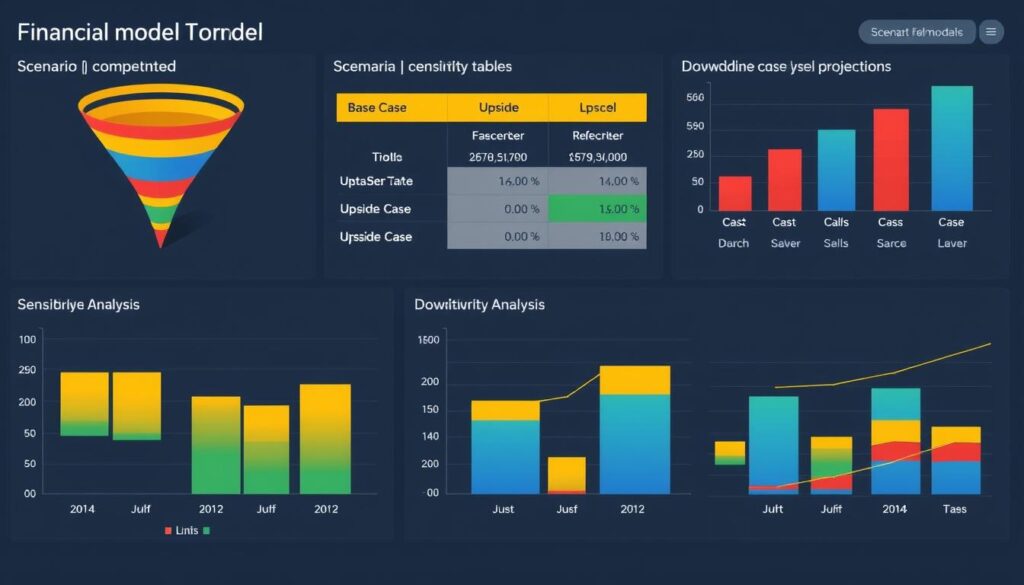
The future is inherently uncertain. Scenario and sensitivity analysis help you understand how your financial projections might change under different conditions, allowing for more robust planning and risk management.
Scenario Analysis: Planning for Different Futures
Scenario analysis involves creating multiple versions of your financial model based on different sets of assumptions. Typically, you’ll want to develop at least three scenarios:
| Scenario | Description | Assumption Adjustments | Purpose |
| Base Case | Your most likely outcome based on reasonable assumptions | Standard assumptions | Primary planning scenario |
| Upside Case | Optimistic but plausible scenario | Higher growth rates, better margins, faster adoption | Understand growth potential and capacity needs |
| Downside Case | Pessimistic but plausible scenario | Lower growth rates, compressed margins, delayed adoption | Stress test, contingency planning |
For each scenario, adjust key assumptions that might vary based on market conditions, competitive landscape, or execution effectiveness. Common variables include:
- Revenue growth rates
- Gross margins
- Customer acquisition costs
- Customer retention rates
- Product launch timing
- Market penetration rates
- Pricing levels
“Plans are worthless, but planning is everything. The very process of planning is invaluable.”
Sensitivity Analysis: Identifying Key Drivers
While scenario analysis examines how multiple variables change together, sensitivity analysis isolates individual variables to understand their specific impact on outcomes.
One-Variable Sensitivity Analysis
This approach shows how changes in a single variable affect key outputs:
| Revenue Growth Rate | 5% | 10% | 15% | 20% | 25% |
| Net Income ($M) | 1.2 | 2.5 | 3.8 | 5.1 | 6.4 |
| Cash Balance ($M) | 3.5 | 5.2 | 7.0 | 8.7 | 10.5 |
| ROI (%) | 8% | 15% | 22% | 29% | 36% |
Two-Variable Sensitivity Analysis
This approach examines how changes in two variables simultaneously affect a key output:
| Net Income ($M) | Revenue Growth Rate | ||||
|---|---|---|---|---|---|
| Gross Margin | 5% | 10% | 15% | 20% | 25% |
| 40% | 0.5 | 1.2 | 2.0 | 2.8 | 3.6 |
| 45% | 0.9 | 1.8 | 2.9 | 3.9 | 5.0 |
| 50% | 1.2 | 2.5 | 3.8 | 5.1 | 6.4 |
| 55% | 1.6 | 3.1 | 4.7 | 6.3 | 7.9 |
| 60% | 2.0 | 3.8 | 5.6 | 7.4 | 9.3 |
Tornado Analysis
A tornado chart visually represents the relative impact of different variables on a key output (like net income or valuation). It helps identify which variables have the greatest influence on your financial outcomes.
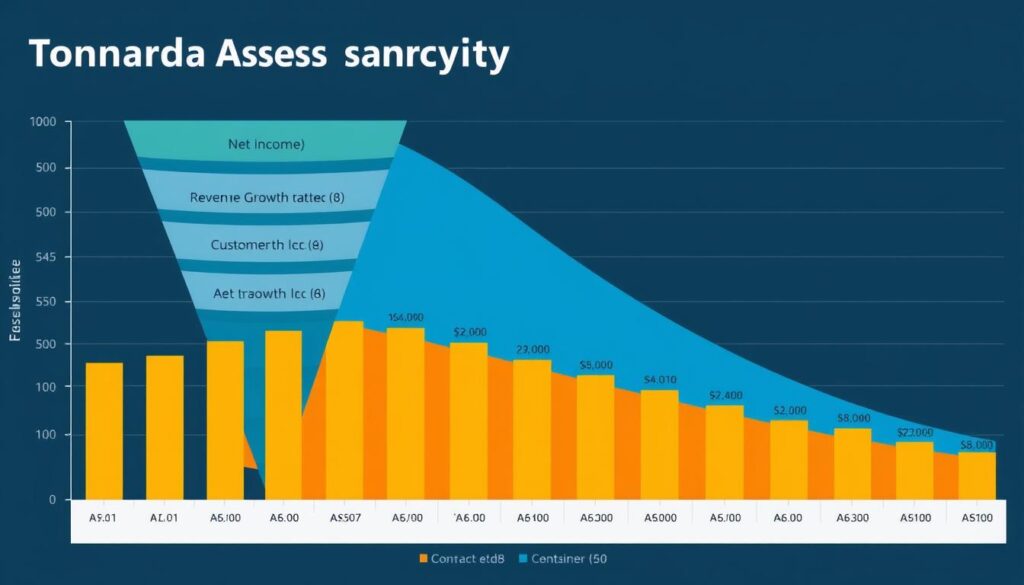
Tornado chart showing the relative impact of key variables on net income
Implementing Scenario and Sensitivity Analysis in Excel
Here are practical techniques for implementing these analyses in your financial model:
- Scenario Manager: Use Excel’s built-in Scenario Manager to create and switch between different scenarios
- Data Tables: Create one-variable and two-variable data tables to perform sensitivity analysis
- Dropdown Menus: Use dropdown menus with VLOOKUP or INDEX/MATCH functions to select different scenarios
- Goal Seek: Use Excel’s Goal Seek function to determine what value a variable needs to be to achieve a specific outcome
- Conditional Formatting: Apply conditional formatting to highlight positive and negative outcomes in sensitivity tables
Master Scenario and Sensitivity Analysis
Download our Scenario Analysis Template with pre-built data tables, tornado charts, and scenario toggles to enhance your financial model.
Step 7: Review, Validate and Refine Your Model
The final step in building a financial business model is thorough validation and refinement. This critical phase ensures your model is accurate, reliable, and truly useful for decision-making.
Error-Checking Your Financial Model
Implement these error checks to identify and fix issues in your model:
Structural Checks
- Balance sheet balance: Assets = Liabilities + Equity
- Cash flow reconciliation: Beginning Cash + Net Cash Flow = Ending Cash
- Income statement flow: Ensure subtotals and totals calculate correctly
- Cross-statement consistency: Verify that linked items match across statements
Logic Checks
- Growth rates: Are projected growth rates reasonable?
- Margin trends: Do margins evolve logically over time?
- Ratio analysis: Do key ratios fall within industry norms?
- Circular references: Check for and resolve any circular references
Common Financial Modeling Errors to Watch For
- Hardcoded numbers embedded in formulas
- Inconsistent time periods across the model
- Broken links between worksheets
- Formulas that don’t copy correctly across columns
- Missing or double-counting transactions
- Unrealistic growth or margin assumptions
- Insufficient working capital to support growth
Validating Model Outputs
Validate your model’s outputs against multiple benchmarks:
- Historical performance: Does the model accurately reflect past performance when using historical inputs?
- Industry benchmarks: Are your projections in line with industry averages and best-in-class performers?
- Competitor analysis: How do your projections compare to similar companies?
- Expert review: Have financial experts or advisors reviewed your model for reasonableness?
- Sanity checks: Do the outputs make intuitive sense given your business context?
Refining and Documenting Your Model
After validation, take these steps to refine and document your model:
- Simplify complex formulas: Break down complex calculations into simpler steps for better transparency
- Add documentation: Include notes explaining key assumptions, data sources, and calculation methodologies
- Create a user guide: Develop instructions for others who may use the model
- Build a dashboard: Create a summary dashboard with key metrics and visualizations
- Version control: Implement a system for tracking model versions and changes
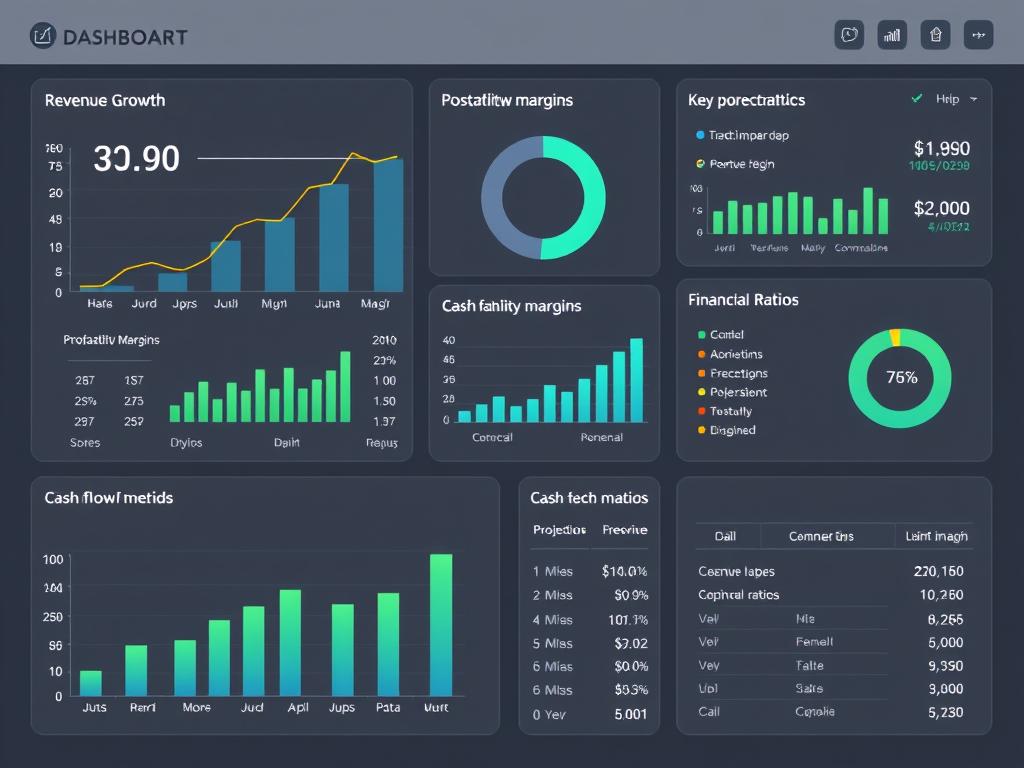
Example of a financial model dashboard summarizing key metrics
Maintaining Your Financial Model Over Time
A financial model is not a one-time project but a living tool that requires ongoing maintenance:
- Regular updates: Update your model with actual results as they become available
- Assumption reviews: Periodically review and adjust key assumptions based on changing conditions
- Variance analysis: Compare actual performance to projections and understand the reasons for variances
- Model evolution: Expand and refine your model as your business grows and changes
- Feedback incorporation: Gather input from model users and incorporate improvements
By thoroughly validating, refining, and maintaining your financial model, you transform it from a static spreadsheet into a dynamic decision-making tool that evolves with your business.
Financial Analysis Example: Retail Business Case Study
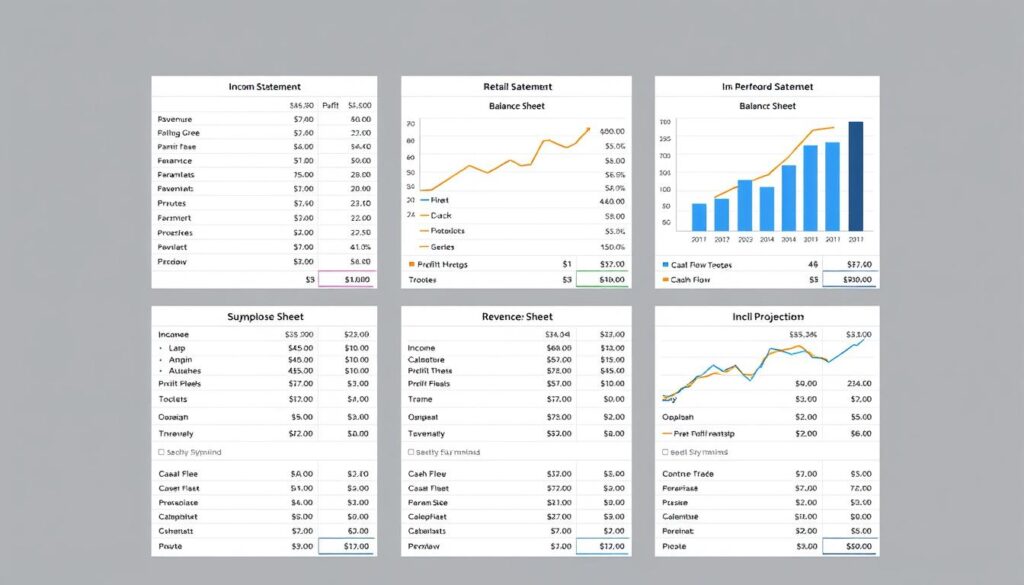
To illustrate the financial modeling process, let’s examine a case study of a retail business expanding its operations. This example demonstrates how to apply the steps we’ve covered to a real-world scenario.
Business Context
RetailCo is a mid-sized specialty retailer with 5 existing stores generating $5 million in annual revenue. The company is planning to open 3 new stores over the next two years and wants to understand the financial implications of this expansion.
Key Questions to Answer:
- How will the expansion affect profitability in the short and long term?
- What funding will be required to support the expansion?
- When will the new stores break even?
- What are the key risks and sensitivities in the expansion plan?
Financial Model Structure
The financial model for RetailCo includes these key components:
- Store-Level Projections: Individual P&L for each store (existing and new)
- Consolidated Financial Statements: Combined results for the entire business
- Capital Expenditure Plan: Investment required for new store openings
- Financing Schedule: Debt and equity funding for the expansion
- Scenario Analysis: Base, upside, and downside cases
Key Assumptions
| Category | Assumption | Basis |
| New Store Revenue | $800,000 in Year 1, growing to $1.2M by Year 3 | Historical performance of existing stores |
| Gross Margin | 45% for existing stores, 42% for new stores in Year 1, increasing to 45% by Year 3 | Current margins and ramp-up pattern from previous openings |
| Store Operating Expenses | $300,000 fixed plus 15% of revenue | Analysis of current store cost structure |
| New Store Capex | $500,000 per store | Recent store opening costs plus inflation adjustment |
| Working Capital | Inventory: 90 days of COGS; A/R: 15 days of sales; A/P: 45 days of COGS | Current working capital metrics |
| Financing | 70% debt (6% interest) / 30% equity for expansion funding | Current capital structure and market rates |
Financial Projections
Income Statement Projection (Consolidated)
| Income Statement ($000s) | Year 0 (Actual) | Year 1 | Year 2 | Year 3 |
| Revenue | 5,000 | 6,600 | 8,700 | 9,900 |
| Cost of Goods Sold | 2,750 | 3,663 | 4,828 | 5,445 |
| Gross Profit | 2,250 | 2,937 | 3,872 | 4,455 |
| Operating Expenses | 1,650 | 2,490 | 3,105 | 3,285 |
| EBITDA | 600 | 447 | 767 | 1,170 |
| Depreciation & Amortization | 200 | 250 | 350 | 350 |
| EBIT | 400 | 197 | 417 | 820 |
| Interest Expense | 50 | 113 | 131 | 125 |
| EBT | 350 | 84 | 286 | 695 |
| Income Tax (25%) | 88 | 21 | 72 | 174 |
| Net Income | 263 | 63 | 215 | 521 |
Cash Flow Projection (Simplified)
| Cash Flow ($000s) | Year 0 (Actual) | Year 1 | Year 2 | Year 3 |
| Net Income | 263 | 63 | 215 | 521 |
| + Depreciation & Amortization | 200 | 250 | 350 | 350 |
| – Change in Working Capital | 50 | 183 | 155 | 88 |
| Operating Cash Flow | 413 | 130 | 410 | 783 |
| – Capital Expenditures | 150 | 1,000 | 500 | 200 |
| Free Cash Flow | 263 | (870) | (90) | 583 |
| + New Debt | 0 | 700 | 350 | 0 |
| + New Equity | 0 | 300 | 150 | 0 |
| – Debt Repayment | 100 | 100 | 150 | 200 |
| Net Cash Flow | 163 | 30 | 260 | 383 |
| Beginning Cash Balance | 400 | 563 | 593 | 853 |
| Ending Cash Balance | 563 | 593 | 853 | 1,236 |
Key Insights from the Financial Model
Financial Impact
- Short-term profit dip in Year 1 due to new store startup costs
- Recovery in Year 2 with strong growth in Year 3
- Total funding requirement of $1.5 million ($1.05M debt, $450K equity)
- Positive free cash flow achieved in Year 3
- Return on investment of 22% by Year 5 (not shown)
Risk Factors
- New store revenue ramp-up is critical to financial success
- Gross margin pressure could significantly impact profitability
- Working capital needs increase substantially with expansion
- Debt service coverage requires careful monitoring
- Potential cannibalization of existing store sales
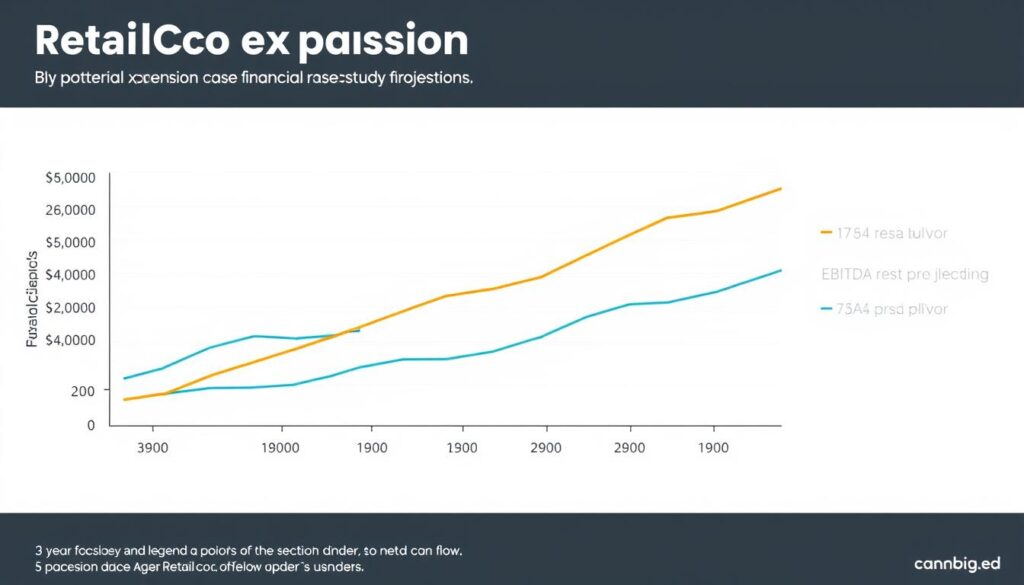
Financial projection summary for RetailCo expansion
This case study demonstrates how a well-structured financial model can provide valuable insights for business decision-making. By quantifying the financial impact of the expansion plan, RetailCo’s management can make informed decisions about timing, funding, and risk mitigation strategies.
Financial Model Templates You Can Use
Building a financial model from scratch can be time-consuming and challenging. These ready-to-use templates can accelerate your financial modeling process while ensuring you follow best practices.
Three-Statement Financial Model Template
A comprehensive template with integrated income statement, balance sheet, and cash flow statement projections.
Key Features:
- 5-year monthly and annual projections
- Customizable revenue drivers
- Expense forecasting by category
- Working capital calculations
- Debt and equity financing schedules
- Dashboard with key metrics and charts
Best For: Startups and small businesses seeking funding or creating business plans
Cash Flow Forecast Template
A detailed cash flow projection tool focused on short-term liquidity planning and management.
Key Features:
- 13-week rolling cash flow forecast
- Weekly and monthly views
- Cash receipt and disbursement scheduling
- Variance analysis (actual vs. forecast)
- Cash flow waterfall charts
- Liquidity risk indicators
Best For: Businesses focused on cash management and working capital optimization
Financial Business Budget Template
A comprehensive budgeting tool for annual planning and performance tracking.
Key Features:
- Department-level budget planning
- Monthly budget allocation
- Actual vs. budget comparison
- Variance analysis and reporting
- Budget revision tracking
- Visual budget dashboards
Best For: Established businesses with departmental budgeting needs
Scenario Analysis Template
A specialized template for creating and comparing multiple business scenarios.
Key Features:
- Base, best, and worst-case scenarios
- Sensitivity analysis tools
- Tornado charts for key variables
- Scenario comparison dashboards
- Probability-weighted outcomes
- Risk assessment metrics
Best For: Strategic planning and risk management
SaaS Financial Model Template
A specialized model for subscription-based software businesses.
Key Features:
- Subscription revenue modeling
- Customer cohort analysis
- Churn and retention tracking
- CAC, LTV, and other SaaS metrics
- Unit economics analysis
- SaaS-specific KPI dashboard
Best For: SaaS startups and established subscription businesses
Valuation Model Template
A comprehensive tool for business valuation using multiple methodologies.
Key Features:
- Discounted Cash Flow (DCF) analysis
- Comparable company analysis
- Precedent transaction analysis
- Weighted average cost of capital (WACC) calculator
- Terminal value calculations
- Valuation summary dashboard
Best For: Business owners considering exit strategies or seeking investment
Need a Custom Financial Model for Your Business?
Our templates are a great starting point, but every business has unique needs. Get a customized financial model tailored to your specific business requirements.
10-Step Strategy for Effective Financial Modeling
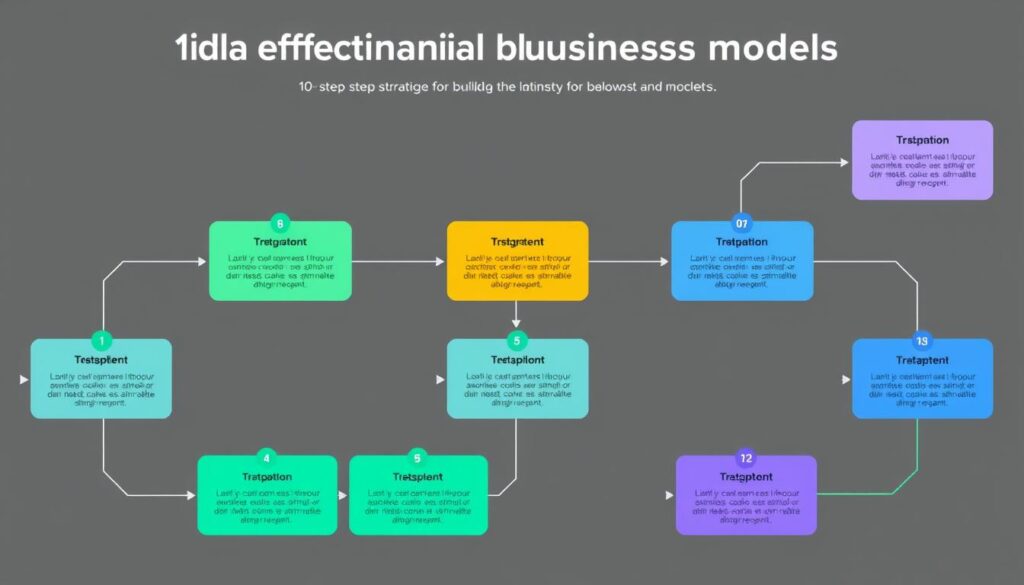
Building on the seven essential steps we’ve covered, here’s a comprehensive 10-step strategy for creating and maintaining effective financial models that drive business success.
-
Start with the End in Mind
Before building your model, clearly define what decisions it needs to support. Is it for fundraising, strategic planning, budgeting, or valuation? The purpose will determine the structure, level of detail, and key outputs required.
Action Step: Create a one-page document outlining the model’s purpose, key questions it should answer, and primary audience.
-
Gather Comprehensive Data
Collect both internal historical data and external market information. For startups without history, research comparable companies and industry benchmarks to establish reasonable assumptions.
Action Step: Create a data inventory listing all required inputs, their sources, and any gaps that need to be addressed.
-
Design a Logical Structure
Organize your model with a clear separation between inputs, calculations, and outputs. Use consistent formatting and color coding to distinguish between different types of cells.
Action Step: Create a model outline with worksheet tabs and major sections before building any formulas.
-
Build Revenue Projections
Develop detailed revenue forecasts based on key business drivers. Use both top-down (market size) and bottom-up (operational capacity) approaches to validate your projections.
Action Step: Identify 3-5 key revenue drivers specific to your business model and create formulas that link them to revenue projections.
-
Model Cost Structure
Analyze fixed vs. variable costs and direct vs. indirect costs. Project each cost category using appropriate methods (percentage of revenue, inflation adjustment, unit-based, etc.).
Action Step: Create a cost classification table categorizing each expense and defining its relationship to business volume.
-
Integrate Financial Statements
Build interconnected income statement, balance sheet, and cash flow statement projections. Ensure consistency across statements with proper linking and checks.
Action Step: Implement balance checks and cash flow reconciliation formulas to verify statement integrity.
-
Implement Scenario and Sensitivity Analysis
Create multiple scenarios (base, upside, downside) and sensitivity analyses to understand how changes in key variables affect outcomes.
Action Step: Identify 5-7 critical variables and create a sensitivity table showing their impact on key metrics.
-
Create a Dashboard
Develop a summary dashboard with key metrics, charts, and visualizations that make the model’s insights accessible to non-financial stakeholders.
Action Step: Design a one-page dashboard with 5-7 key metrics and supporting visualizations.
-
Validate and Stress Test
Thoroughly check your model for errors, inconsistencies, and unrealistic assumptions. Test extreme scenarios to ensure the model behaves logically under stress.
Action Step: Create a validation checklist and have another person review the model for errors and logical consistency.
-
Implement Regular Updates
Establish a process for regularly updating the model with actual results and refining assumptions based on new information and changing conditions.
Action Step: Create a model maintenance schedule with specific update frequencies for different components.
Financial Modeling Success Factors
The most effective financial models share these characteristics:
- Transparency: Clear structure and documentation that makes the model understandable to others
- Flexibility: Ability to adapt to changing assumptions and business conditions
- Accuracy: Reliable calculations and logical consistency across all components
- Relevance: Focus on the metrics and insights that matter most for decision-making
- Usability: Intuitive design that makes the model accessible to its intended users
By following this 10-step strategy, you’ll create financial models that not only provide accurate projections but also deliver actionable insights that drive better business decisions.
Best Tools for Financial Business Planning
While Excel remains the most widely used tool for financial modeling, several specialized applications can enhance your financial planning capabilities. Here’s a comparison of the top tools for different financial modeling needs.
Spreadsheet Applications
| Tool | Best For | Key Features | Limitations | Pricing |
| Microsoft Excel | Custom financial models with complete flexibility |
|
|
$12.50/month (Microsoft 365 Business Basic) |
| Google Sheets | Collaborative financial planning with remote teams |
|
|
Free (Basic), $6/month (Business) |
Specialized Financial Modeling Software
| Tool | Best For | Key Features | Limitations | Pricing |
| Adaptive Planning | Enterprise-level financial planning and analysis |
|
|
Custom pricing (typically $15,000+ annually) |
| Anaplan | Complex, multi-dimensional financial planning |
|
|
Custom pricing (typically $25,000+ annually) |
Financial Modeling Tools for Small Businesses and Startups
| Tool | Best For | Key Features | Limitations | Pricing |
| LivePlan | Business plan creation with financial projections |
|
|
$20/month |
| Finmark | Startup financial planning and fundraising |
|
|
$50/month (Starter), $100/month (Pro) |
Financial Data and Analysis Tools
| Tool | Best For | Key Features | Limitations | Pricing |
| Power BI | Financial data visualization and analysis |
|
|
$10/user/month (Pro), $20/user/month (Premium) |
| Tableau | Advanced financial data visualization |
|
|
$70/user/month (Creator), $42/user/month (Explorer) |
“The best financial modeling tool is the one that matches your specific needs, technical capabilities, and budget. For most businesses, Excel remains the most versatile option, but specialized tools can add significant value for specific use cases.”
When selecting a financial modeling tool, consider these factors:
- Complexity of your financial model: More complex models may benefit from specialized software
- Collaboration requirements: Team-based modeling needs collaborative features
- Integration needs: Consider how the tool connects with your existing systems
- Budget constraints: Balance functionality with cost-effectiveness
- User expertise: Choose tools that match your team’s technical capabilities
- Scalability: Select a solution that can grow with your business
Need Help Choosing the Right Financial Modeling Tool?
Our financial modeling experts can help you select and implement the right tools for your specific business needs.
Common Mistakes to Avoid in Financial Modeling
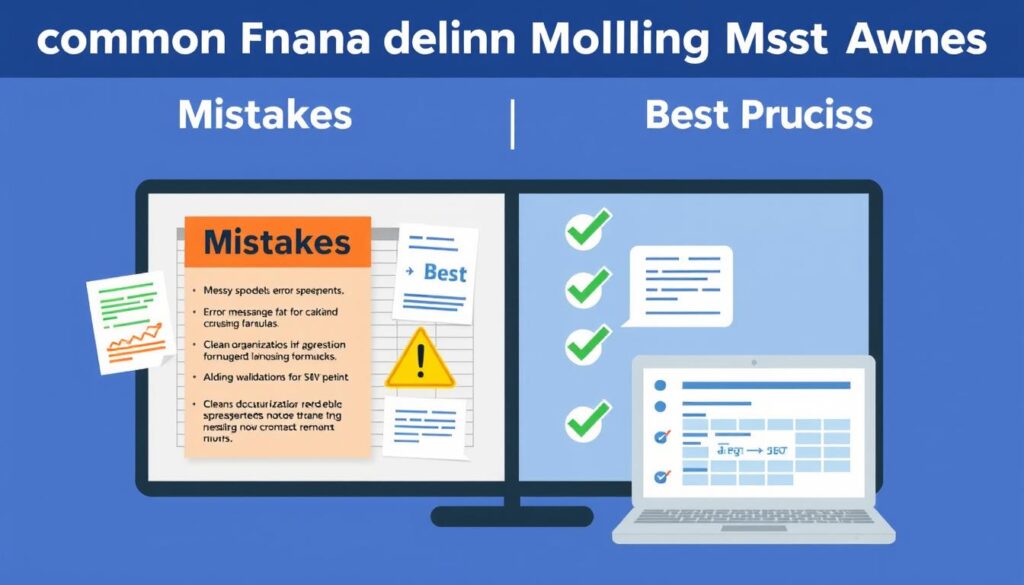
Even experienced financial modelers make mistakes. Being aware of these common pitfalls can help you build more accurate and reliable financial models.
Financial Modeling Best Practices
- Separate inputs, calculations, and outputs
- Use consistent formatting and color coding
- Document assumptions and data sources
- Build in error checks and validation
- Create flexible, scalable structures
- Test multiple scenarios
- Keep formulas simple and transparent
- Regularly update with actual results
- Use named ranges for clarity
- Include a dashboard for key metrics
Common Financial Modeling Mistakes
- Hardcoding numbers in formulas
- Creating overly complex formulas
- Neglecting to document assumptions
- Failing to build in error checks
- Using inconsistent time periods
- Making unrealistic growth projections
- Ignoring working capital needs
- Overlooking circular references
- Mixing inputs and calculations
- Building inflexible, rigid models
Technical Modeling Errors
Formula Errors
Incorrect or inconsistent formulas can undermine your entire model:
- Hardcoded numbers: Embedding constants in formulas makes updates difficult and error-prone
- Inconsistent references: Mixing relative and absolute references inappropriately
- Broken links: References to deleted cells or worksheets
- Circular references: Formulas that refer back to themselves, directly or indirectly
Solution: Use cell references for all variables, implement consistent formula structures, and regularly check for circular references.
Structural Errors
Poor model structure creates confusion and increases error risk:
- Mixing inputs and calculations: Makes updates difficult and increases error risk
- Inconsistent time periods: Misaligned time periods across different sections
- Hidden rows or columns: Conceals important information and calculations
- Excessive complexity: Unnecessarily complex structures that are difficult to audit
Solution: Follow a clear structural framework, maintain consistent time periods, avoid hiding rows/columns, and prioritize clarity over complexity.
Conceptual Modeling Errors
Assumption Errors
Flawed assumptions lead to misleading projections:
- Overoptimistic growth: Projecting unrealistic revenue growth rates
- Margin expansion without basis: Assuming margins will improve without supporting evidence
- Ignoring seasonality: Failing to account for seasonal business patterns
- Inconsistent assumptions: Using contradictory assumptions across different model sections
Solution: Base assumptions on historical data, industry benchmarks, and market research. Document the rationale for key assumptions.
Financial Concept Errors
Misunderstanding financial concepts leads to fundamental model flaws:
- Cash vs. accrual confusion: Mixing accounting methods
- Working capital oversight: Failing to model changes in working capital
- Depreciation errors: Incorrect treatment of capital expenditures and depreciation
- Tax miscalculations: Oversimplified or incorrect tax treatment
Solution: Ensure you understand fundamental financial concepts or consult with financial experts when building your model.
The Most Dangerous Financial Modeling Mistake
Perhaps the most dangerous mistake is false precision — creating a model that appears highly detailed and precise but is built on weak assumptions. This can lead to unwarranted confidence in the model’s outputs and poor decision-making.
Remember that a financial model is a simplification of reality, not reality itself. Even the best models have limitations and uncertainties. Always communicate these limitations when presenting model results.
How to Error-Proof Your Financial Model
- Build in validation checks: Create formulas that verify balance sheet balancing, cash flow reconciliation, and other key relationships
- Use data validation: Apply Excel’s data validation features to restrict inputs to valid ranges
- Implement error alerts: Create conditional formatting to highlight potential issues
- Conduct sensitivity testing: Test extreme values to ensure the model behaves logically
- Peer review: Have someone else review your model for errors and logical consistency
- Document extensively: Include notes explaining complex calculations and key assumptions
- Version control: Maintain a log of model changes and regular backups
By avoiding these common mistakes and implementing error-proofing techniques, you’ll create more reliable financial models that provide trustworthy insights for business decision-making.
Frequently Asked Questions About Financial Business Modeling
What is the difference between a financial model and a budget?
A budget is a specific type of financial plan that allocates resources for a defined period (typically one year) and serves as a performance benchmark. A financial model is a broader analytical tool that can include budgeting but also encompasses forecasting, scenario analysis, valuation, and strategic planning over multiple time horizons.
While budgets focus primarily on planned income and expenses for operational control, financial models integrate multiple financial aspects (income, balance sheet, cash flow) to support various business decisions beyond just resource allocation.
How detailed should my financial business model be?
The appropriate level of detail depends on your model’s purpose, audience, and the complexity of your business. As a general rule, include enough detail to capture the key drivers of your business without creating unnecessary complexity.
For early-stage startups seeking funding, investors typically expect monthly projections for the first 1-2 years and annual projections for years 3-5. For established businesses, more granular detail may be appropriate, especially for operational planning.
Remember that more detail isn’t always better—focus on the factors that materially impact your financial outcomes and simplify where possible.
How far into the future should I project my financial model?
Standard practice for most business financial models is to project 3-5 years into the future. However, the appropriate time horizon depends on your industry and the model’s purpose:
- Startups seeking funding: 3-5 years (monthly detail for years 1-2, annual for years 3-5)
- Established businesses: 3-5 years for strategic planning
- Capital-intensive industries: 5-10 years to capture full investment cycles
- Project finance: Duration of the project (often 10+ years)
- Operational planning: 12-18 months with monthly or quarterly detail
Remember that projection accuracy diminishes with time, so longer projections should focus more on trends and patterns rather than precise numbers.
What are the most important financial ratios to include in my model?
Key financial ratios vary by industry and business model, but these core ratios are valuable for most businesses:
- Profitability ratios: Gross margin, EBITDA margin, net profit margin, return on equity (ROE), return on assets (ROA)
- Liquidity ratios: Current ratio, quick ratio, cash ratio
- Efficiency ratios: Inventory turnover, accounts receivable days, accounts payable days
- Leverage ratios: Debt-to-equity, interest coverage ratio, debt service coverage ratio
- Growth metrics: Revenue growth rate, EBITDA growth rate, earnings growth rate
- Valuation metrics: EV/EBITDA, P/E ratio, P/S ratio (for comparison to public companies)
Additionally, include industry-specific KPIs relevant to your business model (e.g., customer acquisition cost, lifetime value, churn rate for subscription businesses).
How do I forecast revenue for a new business with no historical data?
Forecasting revenue without historical data requires a combination of market research, benchmarking, and structured assumptions:
- Market-based approach: Research your total addressable market (TAM) and estimate a realistic market share percentage you can capture over time
- Comparable company analysis: Study the growth trajectories of similar companies in your industry
- Bottom-up forecasting: Build projections based on operational capacity, sales cycle, and conversion rates
- Unit economics: Calculate revenue based on pricing strategy and projected units sold
- Customer acquisition model: Project customer growth based on marketing spend, conversion rates, and sales capacity
Document all assumptions clearly and consider creating multiple scenarios (conservative, base, and optimistic) to account for uncertainty.
How can I improve the accuracy of my financial business model?
Improving model accuracy requires both technical rigor and business insight:
- Use historical data: Base projections on actual performance when available
- Incorporate market research: Ground assumptions in market realities
- Benchmark against peers: Compare projections to industry standards
- Involve multiple stakeholders: Get input from different departments
- Update regularly: Refine projections as new data becomes available
- Track forecast accuracy: Compare projections to actual results
- Use scenario analysis: Understand the range of possible outcomes
- Implement error checks: Build validation formulas to catch mistakes
- Seek expert review: Have financial professionals review your model
Remember that the goal isn’t perfect prediction (which is impossible) but creating a useful tool for decision-making under uncertainty.
What’s the best way to handle working capital in a financial model?
Working capital modeling requires careful attention to the timing of cash flows. Follow these best practices:
- Model key components separately: Project accounts receivable, inventory, and accounts payable individually
- Use operating metrics: Base projections on metrics like days sales outstanding (DSO), days inventory outstanding (DIO), and days payable outstanding (DPO)
- Link to revenue and COGS: Tie accounts receivable to revenue and inventory/accounts payable to COGS
- Consider seasonality: Adjust for seasonal fluctuations in working capital needs
- Account for growth impacts: Growing businesses typically require additional working capital
- Include other current assets/liabilities: Don’t forget prepaid expenses, accrued liabilities, etc.
Working capital is often underestimated in financial models, but it can significantly impact cash flow, especially for growing businesses or those with seasonal patterns.
How do I incorporate risk analysis into my financial model?
Effective risk analysis in financial modeling involves several techniques:
- Scenario analysis: Create base, worst, and best-case scenarios with different assumption sets
- Sensitivity analysis: Test how changes in key variables affect outcomes
- Monte Carlo simulation: Use probability distributions for key variables to generate a range of possible outcomes
- Break-even analysis: Determine the threshold values where the business becomes profitable
- Stress testing: Test model performance under extreme conditions
- Probability-weighted outcomes: Assign probabilities to different scenarios and calculate expected values
For each identified risk, consider both the likelihood of occurrence and the potential impact on your financial results. Focus your analysis on the variables that have the greatest influence on your key metrics.
Should I use Excel or specialized software for financial modeling?
The choice between Excel and specialized software depends on several factors:
Excel is better when:
- You need complete flexibility in model design
- Your model has unique or complex calculations
- Budget constraints are significant
- Your team has strong Excel skills
- The model doesn’t require extensive collaboration
Specialized software is better when:
- Multiple users need to collaborate simultaneously
- You need integration with other business systems
- Your model requires complex scenario planning
- Data security and version control are critical
- You need advanced visualization capabilities
Many businesses use a hybrid approach—building core models in Excel while using specialized tools for specific functions like data visualization, collaboration, or scenario analysis.
How often should I update my financial business model?
The optimal update frequency depends on your business dynamics and the model’s purpose:
- Monthly: Update with actual results and revise near-term forecasts
- Quarterly: Review and adjust medium-term projections
- Annually: Comprehensive review of all assumptions and long-term projections
- Event-driven: Update when significant events occur (major market changes, new products, acquisitions, etc.)
Fast-growing startups and businesses in volatile industries may need more frequent updates. Established businesses in stable industries might update less frequently.
Regardless of the schedule, establish a regular process for comparing actual results to projections and documenting the reasons for variances. This feedback loop improves forecast accuracy over time.
Conclusion: Turning Financial Models into Strategic Advantages

Building an effective financial business model is both an art and a science. It requires technical skills, business acumen, and a strategic mindset. By following the seven essential steps outlined in this guide, you can create financial models that not only project numbers but drive better business decisions.
Remember that the true value of a financial model lies not in its complexity but in its ability to provide actionable insights. A well-constructed model helps you understand the key drivers of your business, anticipate potential challenges, identify opportunities for growth, and communicate your financial story to stakeholders.
As you apply these principles to your own financial modeling process, keep these key takeaways in mind:
- Start with clear objectives: Define what decisions your model needs to support
- Focus on key drivers: Identify and model the factors that truly impact your business
- Balance detail and usability: Include enough detail to be accurate without creating unnecessary complexity
- Test multiple scenarios: Understand how your business performs under different conditions
- Document assumptions: Make your thinking transparent to yourself and others
- Update regularly: Keep your model current with new information and changing conditions
- Use models as tools, not oracles: Remember that models inform decisions but don’t make them for you
Financial modeling is an ongoing process that evolves with your business. The effort you invest in building robust, insightful models will pay dividends through better decision-making, more efficient resource allocation, and ultimately, improved business performance.
Ready to Build Your Financial Business Model?
Download our comprehensive Financial Modeling Toolkit with templates, guides, and tools to implement everything you’ve learned in this article.
Whether you’re a startup founder seeking funding, a business owner planning for growth, or a financial professional supporting strategic decisions, mastering the steps to build a financial business model will give you a powerful advantage in today’s competitive business environment.